
Laboratory research education only. This article does not provide human or veterinary dosing, administration, diagnosis, treatment, or safety guidance.
The letters are the sequence, not a brand
K, P, and V are the one-letter codes for lysine, proline, and valine, in that order. Calling it a tripeptide just means the chain is three residues long. It does not make the vial milder, stronger, or simpler to document. Short chains are easy to misfile because the name looks like an abbreviation someone made up in a text message.
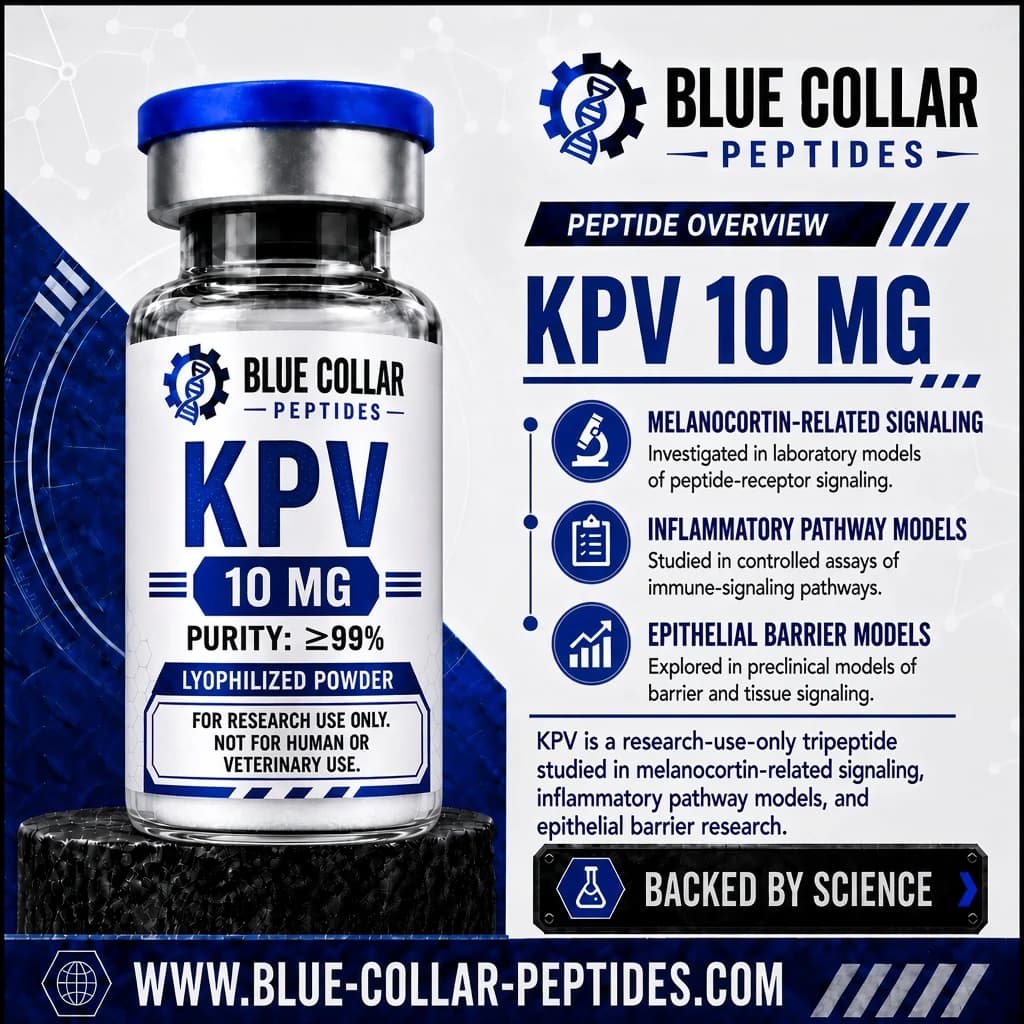
On this catalog the name is KPV 10 mg. Ten milligrams is the labeled amount. $39.99 is the single-vial price. The sequence can sit in a parenthesis in your notes. It should not replace the amount.
Search terms that wander
Search KPV and you will also hit unrelated abbreviations. Search the residue names and you will hit biochemistry that never saw this vial. A PubMed query is a stack to filter, not a certificate. Read whether the paper used a synthetic tripeptide, a fragment of a larger sequence, or a blend that happened to include those letters.
If the methods section names a blend, it is not evidence about the single 10 mg listing. We already have that problem in-house with KLOW. Do not import it from the literature as well.
Three residues change how you talk about mass
A very short peptide has a small molecular mass compared with a 20 mg analog or a protein listed in IU. That fact is a reason to look at a mass result carefully. It is not a reason to invent the mass in the notebook because you added three residue weights on a napkin. If a report prints an observed mass, copy that mass. If it does not, leave the cell blank.
Do not borrow a mass from a GHK-Cu page because both vials are “small.” GHK-Cu 50 mg is a different listing and a different record.
The receiving shorthand
KPV 10 mg, tripeptide Lys-Pro-Val, $39.99, batch if printed. That line is enough for a stranger to find the vial and the page. “KPV stuff” is not enough. Neither is “the copper one,” which is how this vial gets dropped into the GHK-Cu bin.
Cap color and cake height are not part of the identity line. They can be part of the condition line, underneath.
Keep the use line dull
Knowing the residues does not create a set of instructions. Adults 21 and older. Laboratory research only. Not for human or veterinary use.
Spell the residues once, then stop showing off
Lysine-proline-valine is worth one line so a biochemist can see you mean that tripeptide and not an unrelated acronym. It is not worth a paragraph on every receiving entry. After the first full note, KPV 10 mg is the working name. Repeating the residue essay is how the amount and the $39.99 get pushed to the bottom and skipped.
If a new tech does not know the letters, the one-line alias is the training. A lecture in the inventory system is not. Point them at this note, then make them read the cap.
Adults 21 and older. Laboratory research only. Not for human or veterinary use.
If a vendor email spells it KPV and a paper spells the residues out, attach both to the same SKU and move on. Do not open a second inventory item for the spelled-out name. One vial, one price, $39.99, one amount, 10 mg. Aliases live in the note. They do not live as extra stock.
Write the residues in order once, on the SKU card, and then stop spelling them in every email. Lysine, proline, valine. After that the card says KPV 10 mg, $39.99. People who need the long form can flip the card. People who are receiving a box should not have to parse a sentence to find the amount. The spelled-out name is an alias. The bin label is the short one.
Products and current documentation
Product links are provided for specifications, availability, research-use details, and available batch documents. They do not convert cited research into a product claim.
KPV 10 mg
KPV is a research-use-only tripeptide examined in melanocortin-related signaling, inflammatory pathway models, and epithelial barrier research.
View KPV 10 mgBrowse all research materials
Search the complete catalog by product, category, price, stock status, and available documentation.
Shop all productsReferences and further reading
Open the original sources and evaluate their methods, limitations, and applicability independently.
Related education
 FAQs & TerminologyFAQs & Terminology · 8 min readPeptide Research Terminology: A Practical GlossaryPlain-language definitions for batch, analyte, aliquot, chromatogram, identity, purity, specification, and traceability.Read article →
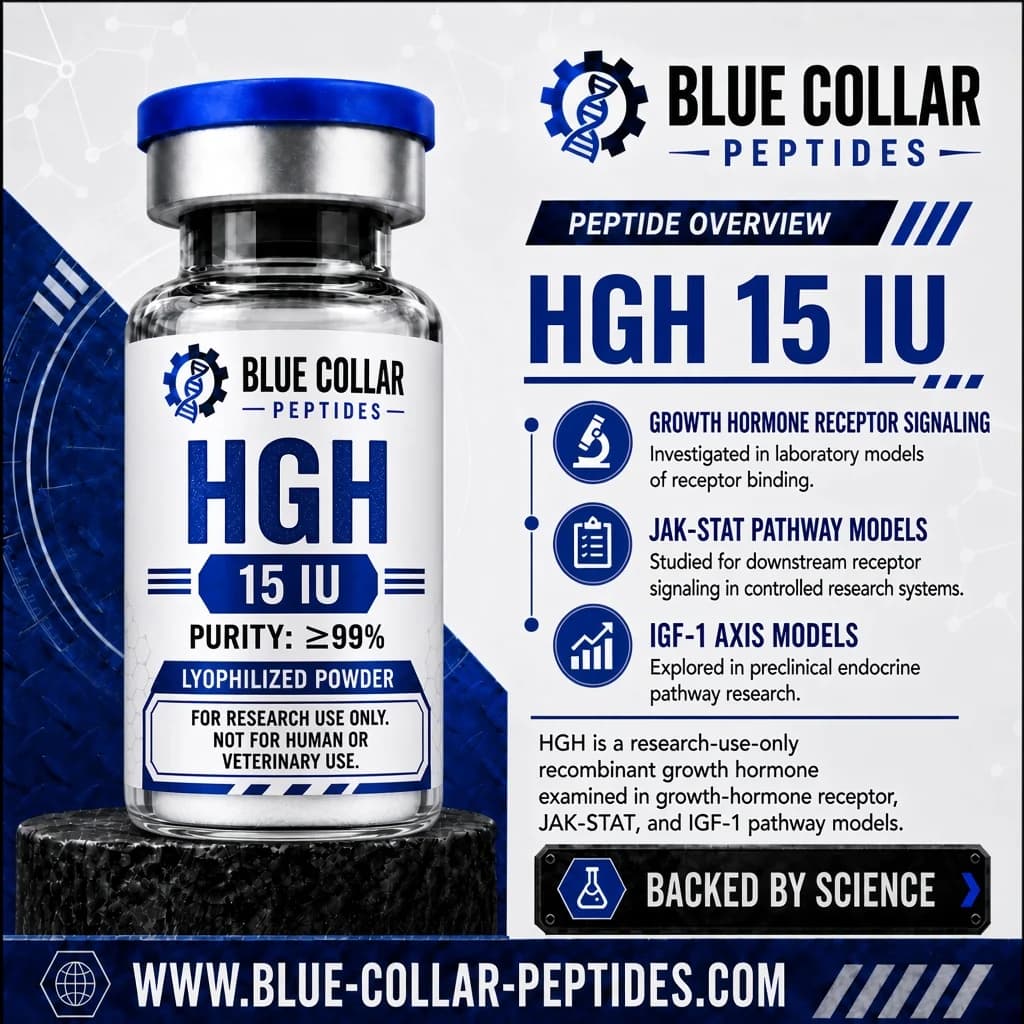 FAQs & TerminologyFAQs & Terminology · 4 min read15 IU Is the Amount. Do Not Turn It into Milligrams.The HGH listing is sold as 15 IU at $45.99. A homemade conversion is not a certificate and it is not the label.Read article →COAs & TestingCOAs & Testing · 4 min readKPV 10 mg Is Not the KPV Line on the KLOW ReportTask 87708 prints KPV 11.75 mg inside a blend. The single vial on this catalog is KPV 10 mg at $39.99. Those are different records.Read article →
Research-use notice
This material is educational and does not provide medical, dosing, administration, treatment, or human-use guidance. For laboratory research use only.