
Laboratory research education only. This article does not provide human or veterinary dosing, administration, diagnosis, treatment, or safety guidance.
Dates stick to files
November 13, 2025, is the analysis date on KLOW task 87708. It is a useful date if you are filing KLOW. It becomes a rumor the moment it is written on a KPV 10 mg receiving line that does not have its own report open. People trust dates. A wrong date looks like diligence.
Write the date you received the single. Write the analysis date only when you are looking at the analysis for that vial.
A note that would survive a stranger
Received KPV 10 mg, count, $39.99 catalog price or the invoice price if it differs, carrier, label readable or not, batch copied from the label if present. Literature alias: lysine-proline-valine tripeptide. Not the KLOW component. Not GHK-Cu.
That is a full note. It does not need a purity percent to look finished. An invented percent would make it worse.
Where the blend date is allowed to appear
In a cross-reference. “Do not use KLOW task 87708 (analyzed November 13, 2025) as the COA for this line.” That sentence uses the date to warn. It does not assign the date to the vial. The difference is the verb.
If you keep a COA index, the warning can live there too, next to an empty task cell for the single.
Physical separation again
KLOW 80 mg and KPV 10 mg should not share a position. The names share three letters. The cakes can look alike. The prices do not: $109.99 versus $39.99. Price is a weak identity check, but a big gap is a reason to look twice, not a reason to assume the cheaper one is a piece of the expensive one.
Read the cap. Then write.
Stop before the protocol
Nothing in the receiving note is a preparation method. Adults 21 and older. Laboratory research only. Not for human or veterinary use.
Two dates, two meanings
Received-on is the day the single hit your bench. Analyzed-on is the day a lab signed a report for that sample. November 13, 2025, is analyzed-on for KLOW task 87708. It can be written in a warning. It cannot be written in the received-on blank, and it cannot be written in an analyzed-on blank for KPV 10 mg unless the KPV file says it.
If your form has only one date field, add a second. One field is how the blend’s birthday becomes the single’s birthday. $39.99 and 10 mg do not carry November 13 with them.
Adults 21 and older. Laboratory research only. Not for human or veterinary use.
If a form export collapses both dates into one column, fix the export before you fix the vials. A CSV that says date is a trap. Name the columns received_on and analyzed_on. Leave analyzed_on blank for the single until its own report exists. November 13, 2025, may appear only in a column you have already labeled as the KLOW warning.
Put November 13, 2025, in one place only: the KLOW note, next to task 87708 and batch 2025-11. If that date shows up in a KPV 10 mg sentence, move the sentence. Dates migrate when people copy a header and forget to clear it. The single vial’s received date is whatever day the box actually arrived, and its analyzed date stays blank until a report names KPV 10 mg and does not name the blend. $39.99 does not inherit a birthday from a different SKU. If you are unsure which date you copied, delete the date and look at the box, not at the blend PDF. The box is the only clock that belongs to this vial. Write that received date in the same ink as the $39.99 so the two facts stay paired.
Products and current documentation
Product links are provided for specifications, availability, research-use details, and available batch documents. They do not convert cited research into a product claim.
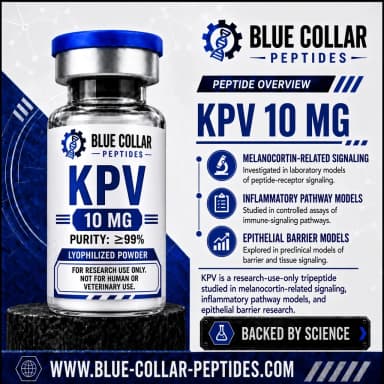
KPV 10 mg
KPV is a research-use-only tripeptide examined in melanocortin-related signaling, inflammatory pathway models, and epithelial barrier research.
View KPV 10 mgBrowse all research materials
Search the complete catalog by product, category, price, stock status, and available documentation.
Shop all productsReferences and further reading
Open the original sources and evaluate their methods, limitations, and applicability independently.
Related education
 Laboratory PracticeLaboratory Practice · 7 min readHow to Read a Peptide Certificate of AnalysisA practical guide to product identity, batch references, test methods, reported results, and document dates.Read article →
 Laboratory PracticeLaboratory Practice · 6 min readWhy Peptide Batch Numbers Matter for TraceabilitySee how one identifier connects labels, analytical records, receiving logs, storage records, and research notes.Read article →Laboratory PracticeLaboratory Practice · 6 min readA Research-Laboratory Peptide Receiving ChecklistA repeatable intake workflow for labels, batch records, container condition, documentation, and storage assignment.Read article →
Research-use notice
This material is educational and does not provide medical, dosing, administration, treatment, or human-use guidance. For laboratory research use only.