Laboratory research education only. This article does not provide human or veterinary dosing, administration, diagnosis, treatment, or safety guidance.
- IdentityConnect the report to the material.
- MethodKnow what question the test answers.
- ResultRead the value with its unit and scope.
- TraceabilityCheck dates and report authorization.
Chromatography provides separation context
HPLC separates detected components and records their response over time. Retention behavior can support comparison under controlled conditions, while a chromatogram alone does not fully establish molecular identity.
Mass spectrometry provides mass evidence
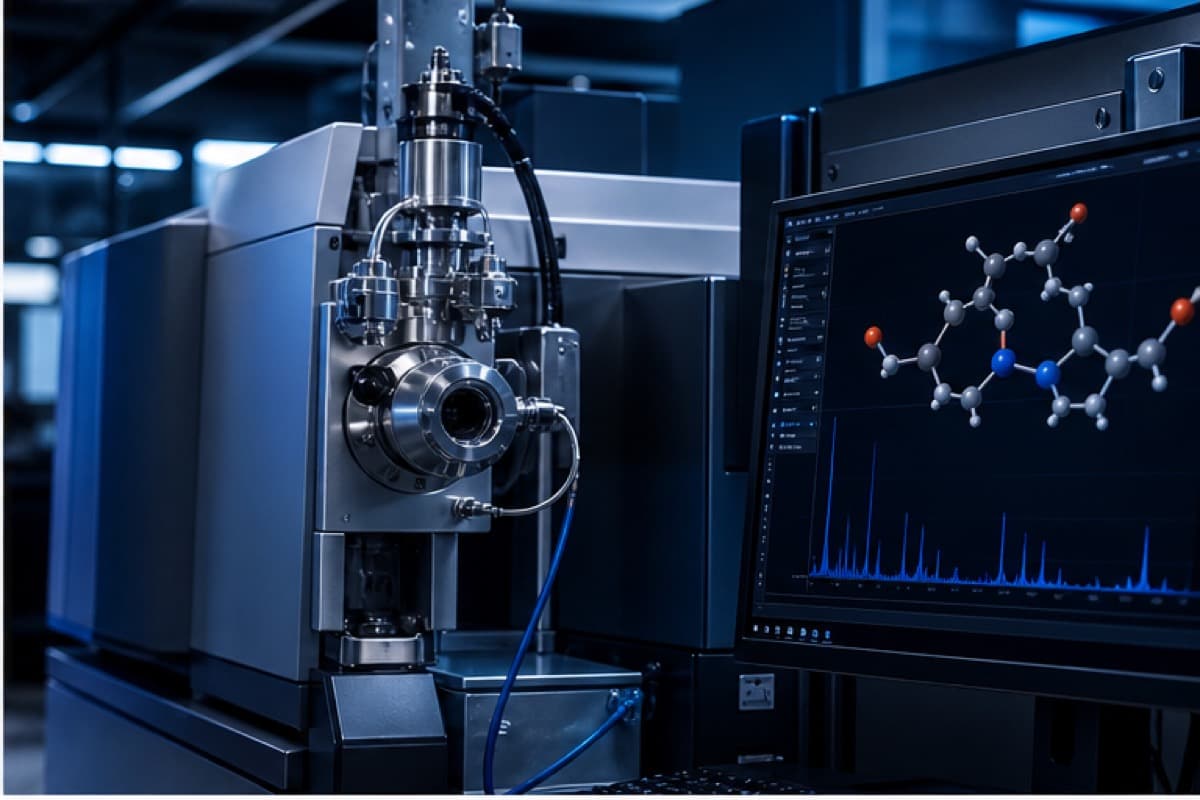
Mass spectrometry measures ions by mass-to-charge ratio. Agreement between expected and observed molecular-mass evidence can support identity when the instrument, method, calibration, and interpretation are appropriate.
Orthogonal evidence reduces ambiguity
Methods based on different scientific principles are often reviewed together because each has distinct strengths and limitations. The report should connect every result to the same sample and batch.
References and further reading
Open the original sources and evaluate their methods, limitations, and applicability independently.
Related education
 COAs & TestingCOAs & Testing · 12 min readA Practical Workflow for Verifying COA AuthenticityA detailed, citation-led guide to issuer identity, report identifiers, sample matching, revision status, signatures, and verification records, written for research documentation and laboratory education.Read article →COAs & TestingCOAs & Testing · 12 min readHPLC vs. Mass Spectrometry: Different Questions, Complementary EvidenceA detailed, citation-led guide to separation, detector response, molecular-mass evidence, method scope, and orthogonal confirmation, written for research documentation and laboratory education.Read article →COAs & TestingCOAs & Testing · 12 min readContent Mass vs. Purity: Why the Numbers Are Not InterchangeableA detailed, citation-led guide to measured quantity, chromatographic area, water, counterions, excipients, calculations, and units, written for research documentation and laboratory education.Read article →
Research-use notice
This material is educational and does not provide medical, dosing, administration, treatment, or human-use guidance. For laboratory research use only.