
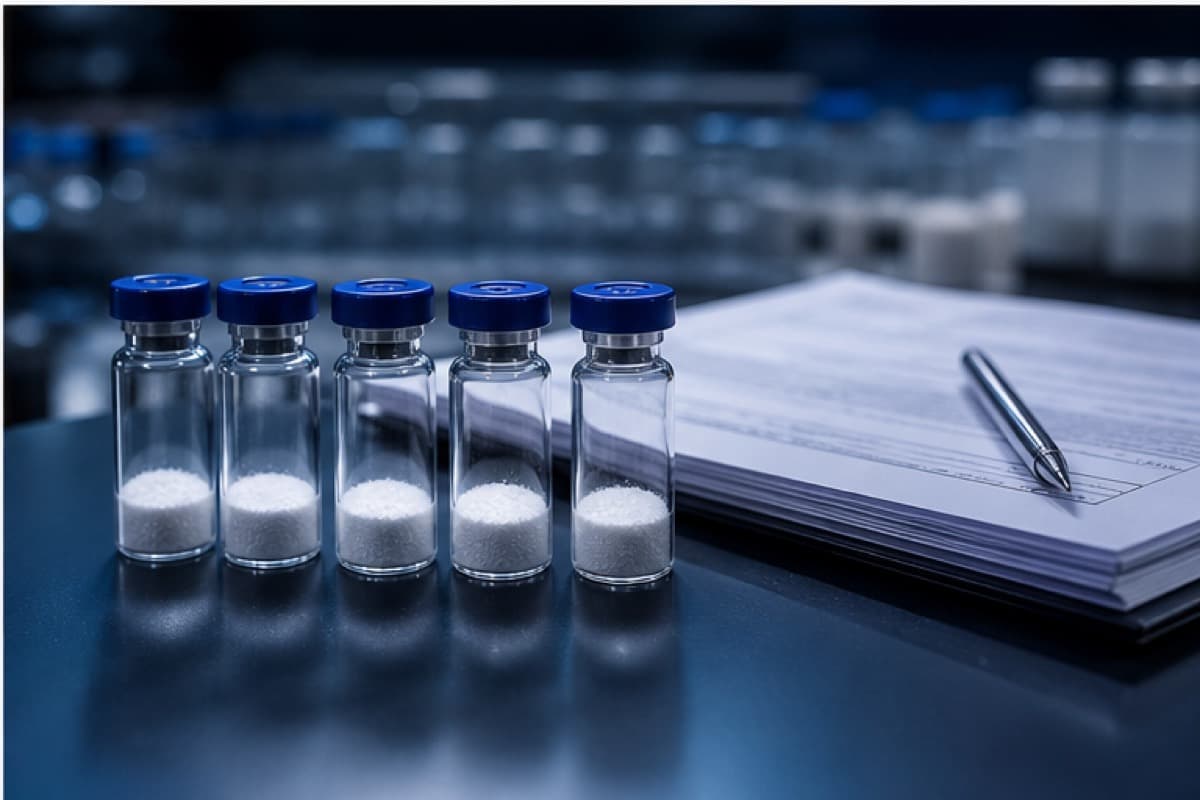
Laboratory research education only. This article does not provide human or veterinary dosing, administration, diagnosis, treatment, or safety guidance.
Use the verified material-specific record—never a universal temperature assumption.
Material behavior is sequence-dependent
Peptides differ in solubility, charge, hydrophobicity, oxidation sensitivity, and tendency to interact with surfaces. A handling rule that works for one material may be unsuitable for another.
Physical conditions matter
Temperature changes, repeated freeze-thaw events, agitation, light exposure, air exposure, and container surfaces may influence a prepared peptide solution. Study records should capture the relevant conditions.
Use a controlled procedure
Researchers should work from material-specific evidence and a defined laboratory procedure. Preparation date, concentration, solvent, container, storage location, and elapsed time are useful record fields.
References and further reading
Open the original sources and evaluate their methods, limitations, and applicability independently.
Related education
Storage & HandlingStorage & Handling · 7 min readLyophilized Peptides Explained: What Freeze-Dried MeansAn educational overview of freeze-drying, solid-state presentation, and why handling instructions remain material-specific.Read article → Storage & HandlingStorage & Handling · 6 min readPeptide Storage Recordkeeping for Research LaboratoriesBuild a practical chain of records for receipt, location, temperature conditions, access, and disposition.Read article →Storage & HandlingStorage & Handling · 6 min readResearch Material Shipping and Receiving: What to DocumentA practical recordkeeping guide for shipment condition, timing, identifiers, discrepancies, and storage transfer.Read article →
Research-use notice
This material is educational and does not provide medical, dosing, administration, treatment, or human-use guidance. For laboratory research use only.