
Laboratory research education only. This article does not provide human or veterinary dosing, administration, diagnosis, treatment, or safety guidance.
- IdentityConnect the report to the material.
- MethodKnow what question the test answers.
- ResultRead the value with its unit and scope.
- TraceabilityCheck dates and report authorization.
Define the GLOW 70 mg question before collecting sources
GLOW is examined as a multi-component blend in analytical and preclinical models involving copper-peptide signaling, cell migration, and actin dynamics. A strong review begins with a written question that identifies the material, experimental model, proposed pathway, comparator, measurement, and time frame. For GLOW 70 mg, catalog research areas such as Multi-peptide interaction models, Copper-peptide signaling, Cell migration and actin dynamics are useful search concepts, not promised outcomes. Translate each concept into synonyms and controlled vocabulary before searching PubMed or another scientific database. Record the full query, filters, dates, and inclusion rules so another reviewer can repeat the work. Decide in advance how identity evidence, chromatographic purity, measured content, method validation, units, and uncertainty will be assessed and what evidence would be considered supportive, conflicting, or inconclusive. This prevents the criteria from shifting after interesting results appear. Keep analytical questions about the material separate from biological questions about an experimental model. A commercial specification, a batch report, and a scientific paper answer different questions. Writing the boundaries first produces a more honest article, a clearer laboratory record, and a more durable basis for future updates.
Confirm material identity and analytical scope
The name GLOW 70 mg does not by itself establish that every source studied an equivalent material. Capture sequence or composition, salt or formulation when reported, nominal amount, measured content, analytical confirmation, preparation conditions, and storage history. Review chromatographic evidence, mass evidence, content measurements, and other tests as separate fields because no single number establishes every quality attribute. A purity percentage does not automatically prove identity, content, sterility, endotoxin status, stability, or biological activity. When a linked COA is available, match the product and report identifiers and read the methods, dates, units, results, and stated limitations. The certificate applies to the sample identified on the report and cannot validate unrelated literature. If a source omits a detail, record “not reported” rather than supplying an assumption. This discipline is essential when evaluating identity evidence, chromatographic purity, measured content, method validation, units, and uncertainty. It also helps readers understand why documentation quality matters without converting analytical data into a clinical or therapeutic claim.
Group evidence by model instead of by headline
Organize GLOW 70 mg evidence into biochemical, cell-based, tissue, animal, observational, and controlled human research categories where applicable. Within each category, capture the model, sample size, controls, randomization, blinding, exposure conditions, endpoint definitions, replicate structure, statistical methods, and author-reported limitations. Do not merge findings merely because the titles use the same product name. Results involving Multi-peptide interaction models, Copper-peptide signaling, Cell migration and actin dynamics can depend on species, cell line, baseline state, assay, timing, and measurement method. A mechanistic observation may generate a useful hypothesis while remaining far removed from a practical outcome. Negative and null results belong in the table alongside positive findings. Evaluate whether the endpoint directly measured the proposed process or relied on a surrogate. This model-first organization makes contradictions visible and prevents one abstract sentence from dominating the review. It also provides a better foundation for discussing identity evidence, chromatographic purity, measured content, method validation, units, and uncertainty with language that matches the actual study design.
Review methods, controls, and measurements
Methods determine the meaning of every result. Record the assay or instrument, calibration and reference approach, sample preparation, system-suitability checks, detection and quantitation limits, recovery, significant figures, and units when available. For biological work, document vehicle controls, positive and negative controls, comparator selection, baseline measurements, prespecified outcomes, exclusions, and missing data. For analytical work, distinguish identity, chromatographic area, molecular-mass evidence, measured content, water or volatile content, and endotoxin screening. Two GLOW 70 mg studies may use similar labels for measurements produced by very different procedures. Establish comparability before calculating a combined value or drawing a ranking. Review whether procedures were validated or otherwise shown to be fit for their stated purpose. A polished graph does not compensate for weak controls or incompatible methods. Method-aware review is particularly important for identity evidence, chromatographic purity, measured content, method validation, units, and uncertainty, because subtle procedural differences can create apparent agreement or conflict that disappears when the underlying methods are examined.
Assess transparency, bias, and independent replication
Read beyond the abstract. Review protocols, registrations, supplementary files, corrections, data availability, funding, conflicts of interest, and the complete limitations section. Follow references backward to foundational experiments and citations forward to replications, critiques, and newer methods. A frequently cited statement may still trace back to one narrow study. For GLOW 70 mg, group independent teams and repeated models separately from papers that reuse the same dataset. Give more weight to transparent methods, appropriate controls, adequate sample sizes, prespecified analyses, complete reporting, and convergent evidence from different approaches. Publication bias can make positive findings easier to locate than null findings, so search broadly and record what the review did not find. Source quality is not determined by a single badge or journal metric. A balanced evaluation of identity evidence, chromatographic purity, measured content, method validation, units, and uncertainty explains both why a finding is informative and why its interpretation remains bounded.
Build a traceable material and data record
Connect the GLOW 70 mg purchasing record, label, SKU, lot or batch identifier when supplied, receiving date, storage location, COA, preparation record, experiment identifier, raw data, analysis version, and final disposition. Preserve original files and maintain reviewed copies separately when annotations are required. Record environmental exposure, container changes, transfers, preparation calculations, elapsed time, and deviations under the laboratory’s approved procedure. Arithmetic can describe mass, volume, or concentration, but it cannot establish solubility, compatibility, stability, or experimental suitability. Those decisions require material-specific evidence. Apply attributable, legible, contemporaneous, original, and accurate record principles so a reviewer can reconstruct what happened without relying on memory. These records make identity evidence, chromatographic purity, measured content, method validation, units, and uncertainty more credible because the observed result can be connected to a defined material history and a documented analysis path.
Write conclusions at the strength of the evidence
Use calibrated verbs: a study measured, observed, reported, suggested, did not detect, or generated a hypothesis under specified conditions. Avoid changing association into causation, a preclinical observation into a human outcome, or a batch result into a universal product claim. Do not describe GLOW 70 mg as safe, effective, therapeutic, proven, or appropriate for human or veterinary use based on research-only material or an educational summary. Name the model, measurement, uncertainty, conflicting evidence, and limits of generalization near the conclusion—not hidden in a final footnote. Separate catalog specifications and availability from published findings. Product and COA links on this page support navigation and document review; they do not mean that every cited experiment applies to a current batch. Clear language around identity evidence, chromatographic purity, measured content, method validation, units, and uncertainty improves trust and makes the article easier to revise when stronger evidence becomes available.
Continue the GLOW 70 mg review responsibly
Use the citations below as starting points, then open and evaluate the original papers. Save the exact search strategy, screening decisions, extraction table, and date of the review. Compare studies that use genuinely similar models and endpoints, and keep unresolved questions visible. Visit the connected GLOW 70 mg product page for current specifications, stock information, research-use details, and any available batch document. Use the Education Center comparison guides, storage resources, terminology pages, and laboratory calculators only within their stated scope. Apply institutional procedures for facilities, training, controls, documentation, waste handling, and review before laboratory work. Nothing in this article provides human or veterinary dosing, administration, diagnosis, treatment, or safety guidance. When verified evidence is missing, define the evidence needed instead of filling the gap with a confident claim. That practice turns uncertainty into a testable next question and keeps identity evidence, chromatographic purity, measured content, method validation, units, and uncertainty anchored to reproducible research.
Use comparison articles without treating different materials as interchangeable
Comparison pages can clarify how research questions, analytical records, and experimental models differ, but they should not collapse distinct materials into a single category. When comparing GLOW 70 mg with another catalog material, begin with equivalent naming, amount, formulation, analytical scope, and document date. Then compare the published research by model, endpoint, and method rather than by a broad marketing category. One material may have extensive mechanistic literature while another has a narrower analytical or preclinical record; that difference is itself an important finding. Do not rank materials using unlike endpoints or assume that a result in one model predicts a result in another. Record whether a comparison is direct within one study or constructed across separate sources. Cross-study comparisons carry additional uncertainty because procedures, populations, controls, and analysis choices may differ. Use linked comparison guides as navigation aids, return to the cited primary sources, and keep the research-use-only boundary explicit. This approach makes comparisons more informative while avoiding recommendations, stacking guidance, or implied suitability for human or veterinary use.
Maintain the article as new evidence and documentation appear
A trustworthy GLOW 70 mg guide needs a maintenance record. Set a scheduled review date and update sooner when a major correction, retraction, method change, new systematic review, revised analytical document, or material-specification change becomes available. Save database alerts using the documented search terms and screen new records against the same inclusion rules used for the original review. Record additions, removals, changed interpretations, broken links, and the reviewer responsible for each revision. Recheck the connected product page, COA Library, storage guide, terminology, and related comparison pages so internal links remain accurate. Confirm that units, product names, dates, image descriptions, canonical links, and structured metadata match the visible article. Do not silently rewrite an earlier conclusion; explain why the evidence assessment changed. Preserve superseded working files according to the laboratory or editorial record procedure. A visible publication date should describe the article’s release, while a modified date should change only after a substantive review. Ongoing maintenance turns a large Education Center into a dependable reference rather than a collection of pages that gradually drift away from their cited evidence.
Products and current documentation
Product links are provided for specifications, availability, research-use details, and available batch documents. They do not convert cited research into a product claim.
GLOW 70 mg
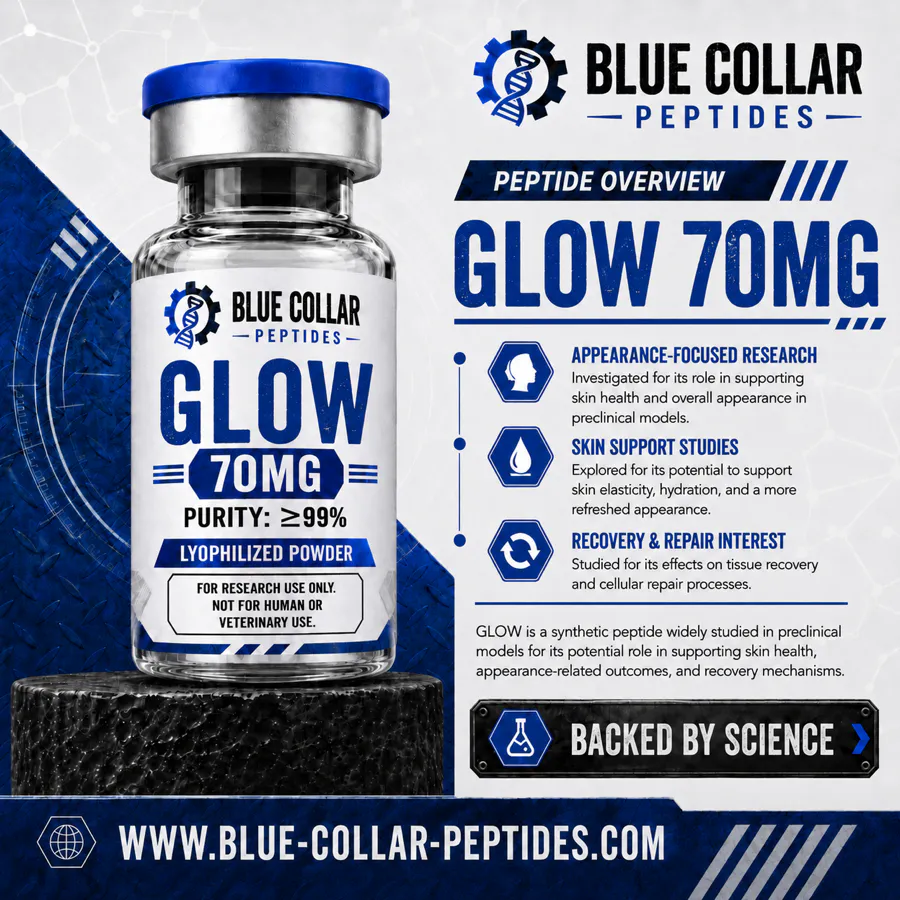
GLOW is examined as a multi-component blend in analytical and preclinical models involving copper-peptide signaling, cell migration, and actin dynamics.
View product →View current COA →Browse all research materials
Search the complete catalog by product, category, price, stock status, and available documentation.
Shop all productsReferences and further reading
Open the original sources and evaluate their methods, limitations, and applicability independently.
- PubMed — GLOW 70 mg research search ↗
- National Library of Medicine — PubMed User Guide ↗
- NIH — Rigor and Reproducibility ↗
- FDA — Analytical Procedures and Methods Validation ↗
- ICH — Q2(R2) Validation of Analytical Procedures ↗
- NIST — Reference Materials ↗
- PMC — Recommendations for peptide storage and handling in mass-spectrometry assays ↗
Related education
 COAs & TestingCOAs & Testing · 12 min readA Practical Workflow for Verifying COA AuthenticityA detailed, citation-led guide to issuer identity, report identifiers, sample matching, revision status, signatures, and verification records, written for research documentation and laboratory education.Read article →
 COAs & TestingCOAs & Testing · 12 min readHPLC vs. Mass Spectrometry: Different Questions, Complementary EvidenceA detailed, citation-led guide to separation, detector response, molecular-mass evidence, method scope, and orthogonal confirmation, written for research documentation and laboratory education.Read article →COAs & TestingCOAs & Testing · 12 min readContent Mass vs. Purity: Why the Numbers Are Not InterchangeableA detailed, citation-led guide to measured quantity, chromatographic area, water, counterions, excipients, calculations, and units, written for research documentation and laboratory education.Read article →
Research-use notice
This material is educational and does not provide medical, dosing, administration, treatment, or human-use guidance. For laboratory research use only.