
GLP-RT3 vs GLP-1SG
An educational comparison of GLP-RT3 vs GLP-1SG, including research context, mechanisms, documentation, and evidence limitations.
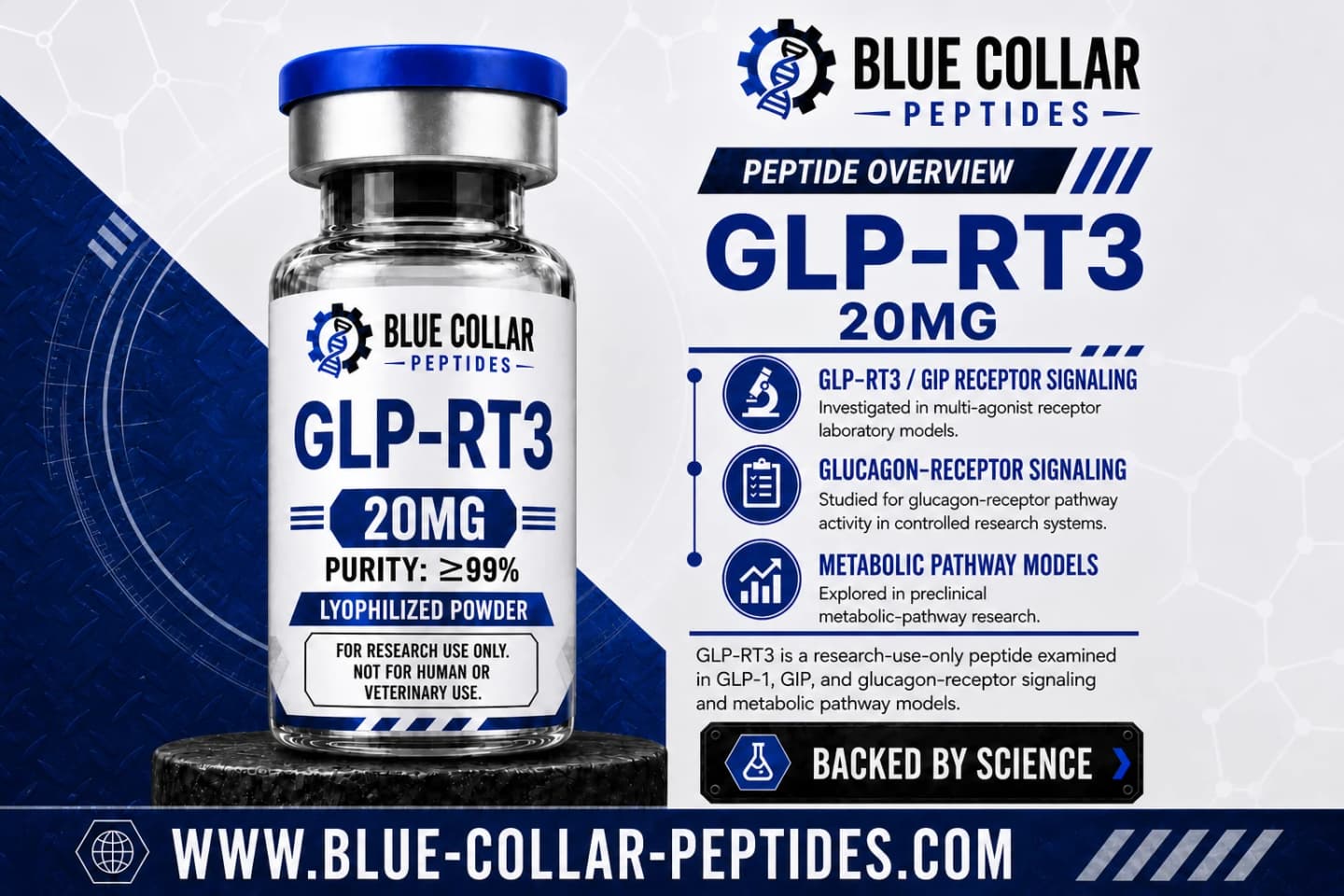 20 mg
20 mgGLP-RT3 20 mg
GLP-RT3 is studied in multi-agonist receptor models involving GLP-1, GIP, and glucagon-receptor signaling and metabolic pathways.
Open research guide →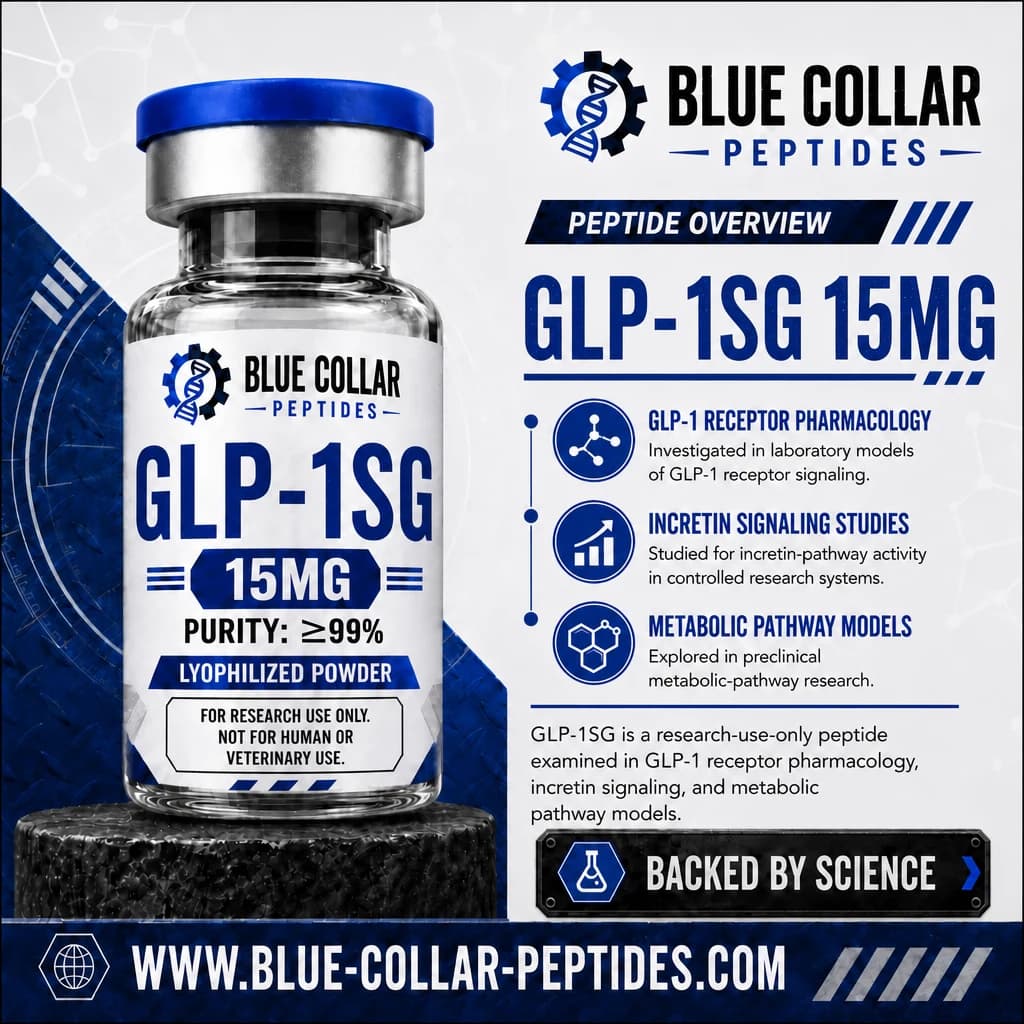 15 mg
15 mgGLP-1SG 15 mg
GLP-1SG is studied in laboratory models of GLP-1 receptor pharmacology, incretin signaling, and metabolic pathways.
Open research guide →The central difference
GLP-RT3 20 mg and GLP-1SG 15 mg are grouped together because researchers may encounter overlapping themes, but they are not interchangeable. GLP-RT3 20 mg is organized around glp-1/gip receptor signaling, glucagon-receptor signaling, multi-agonist pathway models, while GLP-1SG 15 mg is organized around glp-1 receptor pharmacology, incretin signaling, metabolic pathway models. A useful comparison begins with targets and experimental questions rather than a claim that one material is “better.”
Every material connected to the Blue Collar Education Center is presented for qualified laboratory research use only. It is not offered for human or veterinary use. Nothing in the Education Center is a diagnosis, treatment recommendation, safety assurance, administration instruction, or substitute for review by an appropriately qualified institution.
Research pathways
GLP-RT3 is studied in multi-agonist receptor models involving GLP-1, GIP, and glucagon-receptor signaling and metabolic pathways. By comparison, GLP-1SG is studied in laboratory models of GLP-1 receptor pharmacology, incretin signaling, and metabolic pathways. These descriptions identify literature themes, not expected human outcomes. The strength of any conclusion depends on the exact compound, model, method, exposure, endpoint, and quality of the study.
Every material connected to the Blue Collar Education Center is presented for qualified laboratory research use only. It is not offered for human or veterinary use. Nothing in the Education Center is a diagnosis, treatment recommendation, safety assurance, administration instruction, or substitute for review by an appropriately qualified institution.
Study design differences
When comparing GLP-RT3 20 mg and GLP-1SG 15 mg, separate biochemical assays, cell models, animal studies, and human research. A receptor-binding experiment and an organism-level outcome are different evidence categories. Build a table of study type, sample, comparator, endpoint, duration, uncertainty, and limitations before comparing results.
Every material connected to the Blue Collar Education Center is presented for qualified laboratory research use only. It is not offered for human or veterinary use. Nothing in the Education Center is a diagnosis, treatment recommendation, safety assurance, administration instruction, or substitute for review by an appropriately qualified institution.
Analytical documentation
The catalog lists GLP-RT3 20 mg at 20 mg and GLP-1SG 15 mg at 15 mg. Labeled amount, measured content, chromatographic purity, identity, and endotoxin results are different attributes. Use each product's linked COA to review the sample-specific evidence rather than transferring a result from one product or batch to another.
Identify the exact compound, sequence or formulation, experimental model, comparator, exposure conditions, endpoint, units, replicate count, and statistical approach. Then determine whether the conclusion matches the data shown. A molecular interaction can be scientifically meaningful without establishing a clinical outcome, and an animal result can generate a hypothesis without proving what happens in humans.
Storage and preparation
Handling requirements can differ with sequence, formulation, container, solvent, concentration, temperature, light, and time. Use verified material-specific documentation. A comparison article cannot establish a universal storage or reconstitution procedure for either material.
Identify the exact compound, sequence or formulation, experimental model, comparator, exposure conditions, endpoint, units, replicate count, and statistical approach. Then determine whether the conclusion matches the data shown. A molecular interaction can be scientifically meaningful without establishing a clinical outcome, and an animal result can generate a hypothesis without proving what happens in humans.
How to read conflicting findings
Differences between studies may reflect model selection, endpoint definitions, formulation, analytical sensitivity, sample size, controls, or publication bias. Conflicting findings are not noise to hide; they are information about uncertainty. Give more weight to transparent methods, appropriate controls, replication, and systematic evidence review.
Every material connected to the Blue Collar Education Center is presented for qualified laboratory research use only. It is not offered for human or veterinary use. Nothing in the Education Center is a diagnosis, treatment recommendation, safety assurance, administration instruction, or substitute for review by an appropriately qualified institution.
Choosing an experimental question
A laboratory should choose between GLP-RT3 20 mg, GLP-1SG 15 mg, both, or neither based on a predefined scientific question and an approved protocol. Commercial availability is not evidence of suitability. This comparison supports literature navigation and documentation review only.
Identify the exact compound, sequence or formulation, experimental model, comparator, exposure conditions, endpoint, units, replicate count, and statistical approach. Then determine whether the conclusion matches the data shown. A molecular interaction can be scientifically meaningful without establishing a clinical outcome, and an animal result can generate a hypothesis without proving what happens in humans.
Responsible conclusion
The responsible conclusion is not a winner. GLP-RT3 20 mg and GLP-1SG 15 mg have distinct research profiles, and overlap does not erase their mechanistic differences. Readers should use the linked PubMed indexes to inspect original studies and the Blue Collar COA Library to inspect available analytical documents.
Research summaries are organized around the scientific question, model, target, analytical method, and limitations. The editorial goal is to help readers navigate literature without converting preliminary observations into marketing promises. Product availability and analytical documentation are connected to the article, but commercial information is kept visibly separate from scientific interpretation.
How Blue Collar Peptides builds research summaries
Research summaries are organized around the scientific question, model, target, analytical method, and limitations. The editorial goal is to help readers navigate literature without converting preliminary observations into marketing promises. Product availability and analytical documentation are connected to the article, but commercial information is kept visibly separate from scientific interpretation.
Terminology is standardized across the Blue Collar Education Center. Identity, purity, content mass, endotoxin, stability, pharmacokinetics, and biological activity are treated as different concepts. When evidence is incomplete, model-specific, conflicting, or unavailable, the guide says so. Pages are reviewed as educational resources and do not provide medical, veterinary, dosing, or treatment advice.
A checklist for reading any peptide paper
Identify the exact compound, sequence or formulation, experimental model, comparator, exposure conditions, endpoint, units, replicate count, and statistical approach. Then determine whether the conclusion matches the data shown. A molecular interaction can be scientifically meaningful without establishing a clinical outcome, and an animal result can generate a hypothesis without proving what happens in humans.
Look for independent replication, preregistration when applicable, transparent methods, accessible data, appropriate controls, negative findings, and clearly disclosed conflicts of interest. Compare papers that use similar models and endpoints before comparing headline results. Record unanswered questions rather than filling gaps with assumptions.
Research-use boundary
Every material connected to the Blue Collar Education Center is presented for qualified laboratory research use only. It is not offered for human or veterinary use. Nothing in the Education Center is a diagnosis, treatment recommendation, safety assurance, administration instruction, or substitute for review by an appropriately qualified institution.
The calculators are limited to laboratory unit conversion, stock concentration, and aliquot recordkeeping. They intentionally do not provide schedules, injection instructions, cycles, or human/veterinary dose recommendations. The half-life reference is a literature-navigation tool and not an administration schedule.
A reproducible literature-review method
Begin with a written search question and record the databases, keywords, synonyms, date range, language limits, and study types used. Screen titles and abstracts against the same inclusion rules before reading full papers. For every included source, capture the experimental model, sample size, comparator, material identity, route or exposure conditions, analytical method, endpoints, uncertainty, and author-reported limitations. This prevents a memorable headline from carrying more weight than the underlying methods. It also makes later updates possible because another reviewer can repeat the search and understand why a paper was included or excluded.
Evidence should be grouped by model rather than blended into one conclusion. Cell-culture observations, animal experiments, analytical characterization, and controlled human studies answer different questions. A result in one model does not automatically predict a result in another. Note whether a paper is exploratory, confirmatory, randomized, blinded, replicated, or independently reproduced. Record null and conflicting findings alongside positive findings. A useful research library shows the shape and limits of the evidence instead of using citation count as a substitute for critical appraisal.
Documentation and data-quality controls
Treat the catalog record, label, COA, receiving record, storage log, preparation record, experiment record, and raw instrument output as connected but distinct documents. Verify that names, units, dates, and identifiers agree before drawing a conclusion. Where a source does not report a value, mark it as not reported; do not estimate it from a nearby field. Keep purity, identity, measured content, sterility, endotoxin, residual solvents, and biological activity separate because each depends on a different method, specification, and interpretation.
When comparing values, check the denominator, significant figures, calibration approach, reference standard, recovery, uncertainty, and whether the number is nominal or measured. Preserve the original unit and unrounded value, then document any conversion. A clean table can hide incompatible methods, so the written review should identify what is truly comparable. This discipline is especially important when a resource links educational literature with a commercial product: the literature explains a research topic, while the product document describes only the sample and scope printed on that report.
References and further reading
- PubMed literature index — GLP-RT3 20 mg ↗
A continuously updated index of peer-reviewed biomedical literature. Study quality, model, and relevance must be assessed individually.
- PubMed literature index — GLP-1SG 15 mg ↗
A continuously updated index of peer-reviewed biomedical literature. Study quality, model, and relevance must be assessed individually.
- FDA — Analytical Procedures and Methods Validation ↗
Regulatory guidance on analytical method development and validation.
- ICH Q2(R2) — Validation of Analytical Procedures ↗
International guidance on specificity, accuracy, precision, range, and robustness.
External links are provided for independent literature review. A link does not imply that every indexed paper supports the same conclusion or that findings apply beyond the model and conditions studied.